A quarter century after Janet Marinelli sent me a copy of Stalking the Wild Amaranth, I noticed it, hidden away in my large horticultural library, unread, and picked it up to take along on a week-long trip to the east coast of Florida where I peck these thoughts. I had known Janet casually in her capacity as director of publication when I served as vice chair of the Brooklyn Botanic Garden board. We both served under the brilliant leadership of Judy Zuk, then President of BBG, and so sadly missed by me to this day. I have lost track of Janet, unfortunately, but not her book and its many prescient provocations which sound as if she could have written it yesterday. The title is nothing if not confusing (which is maybe why I never read it back then – was I really interested in stalking Amaranths, wild or otherwise?) but the subtitle says it all: Gardening in the Age of Extinction.
The book alternates enjoyable anecdotal reading (citing examples from her Brooklyn and Shelter Island gardens, along with summarized histories of garden trends) with heavy doses of the science of evolutionary biology, including the recent history of the emerging study of biosystems and ecology. For me, an architect, I identified as both Le Corbusier and Frank Lloyd Wright – even Gustav Stickley and Andrew Jackson Downing – figure in. And in a few poetic pages she describes how my beloved Brooklyn Botanic Garden developed from an ash dump at the turn of the twentieth century to become the “symbol of the kind of ecological transformation that may be effected in our own backyards.”
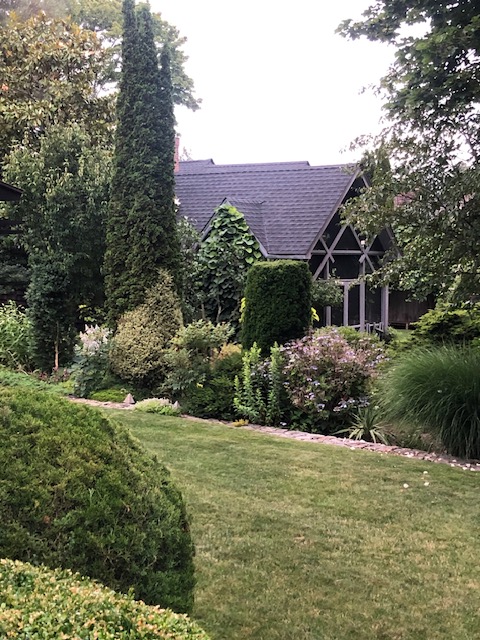
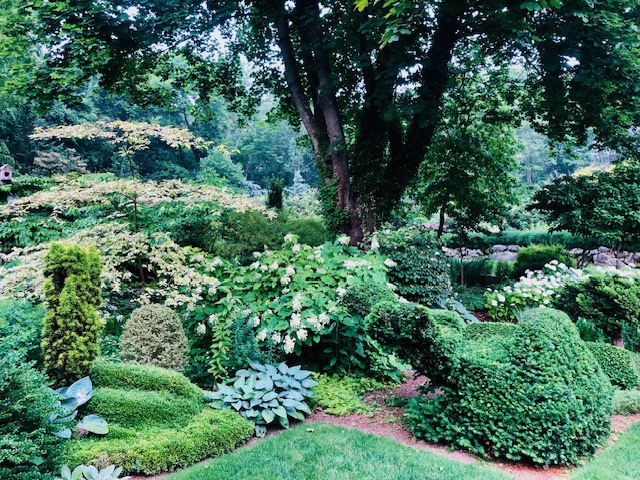
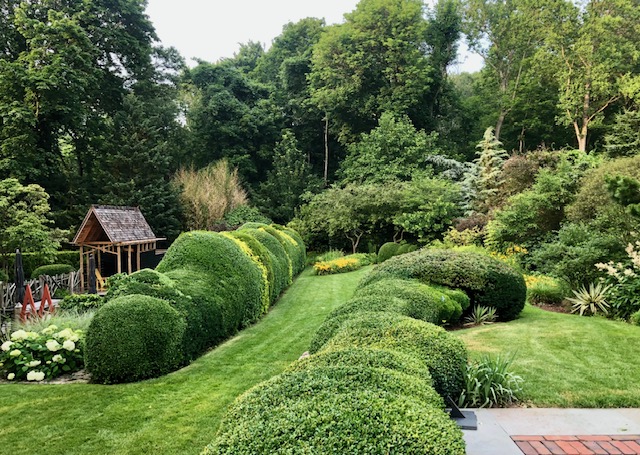
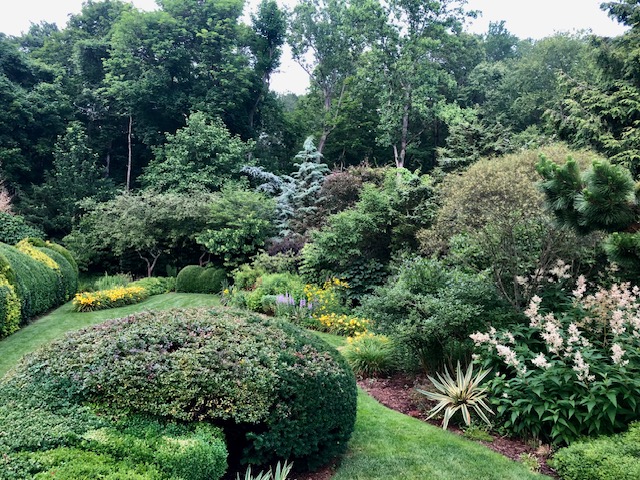
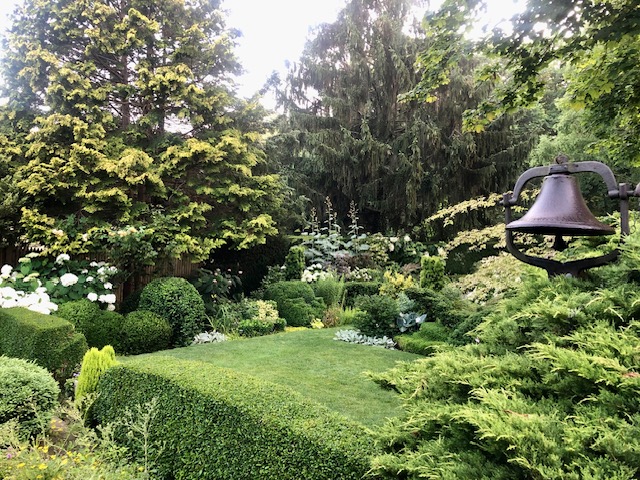
As enjoyable as I found the book, it was profoundly disturbing, producing a panic of angst and guilt that “my” kind of gardening is not only not avant garde but is actually rear garde. Uptop is a highly designed (I am an architect, after all) pictorially-focused garden of collectibles – exotics, if you will – whose origins come from every corner of the earth. Lots of diversity (Janet assures me this is good) but few consciously planted native species. I carry a heavy load of Western cultural baggage, especially of an Anglo tilt. Great Dixter and Sissinghurst were my early muses, with Jacques Wirtz and Piet Oudolf mixed in, even as I tried to make an American version with the likes of Robert Dash as a guide. My garden is nothing if not a visual treat for the eyes: color, texture, form all arranged just the way I wanted it – and rearranged, at will, when the fancy strikes me…perilously close to decorating, I cringe. Am I just an exterior decorator? Organic (yes, mostly)… Composting (yes, in abundance)… Pollinators (yes, increasingly)… Invasives (even as the Connecticut list grows longer, most have been eliminated)…No-till (yes, mostly)… Leaving until Spring the cutting back of perennials and grasses (absolutely)… but I am not an ecological gardener, at least not yet. Reassuringly, Janet says she is not suggesting “that such painterly considerations should have no place in the ecological garden, just that the pictorial sense should be grounded in the larger natural context.” Is it too late for me? Surely at 78 years old and the garden at a handsomely mature 30, I will not be ripping it all out, only to plant native species (and those mostly in gravel in a xeriscape paradise). The truth is I don’t even like the formlessness of most native plant gardens, except in woodland settings (which I have but they are small) or meadows (which I don’t possess), even if I know they are playing a vital role.
Quoting Janet further: “I’m convinced that the environmental heroes of the twenty-first century will in fact be humble gardeners – gardeners who believe that it is their responsibility, maybe even their destiny, to promote a richer evolution of life on Earth through a new, ecologically wise landscape art.” Angst and guilt: I want to be that humble gardener but fear I am not responsibly making the grade.
She ends her beautiful book thus: “And so, as great gardeners have always done, we must reinvent our relationship with the rest of nature in a fertile, creative and playful way. Not only our own backyards but also the entire globe must become our garden. Together, the art of landscape design and the science of ecology can remake the surface of the planet. The goal of this new landscape art will be nothing less than the enhancement of the beauty and complexity of the universe through the nurturing of a greater richness and variety of earthly life.”
Janet’s book has made a new convert, albeit, rather late – and albeit, a convert with a lot of baggage which I refuse to abandon. So, what to do? I think I will do what Russell Page did to end his essential primer, The Education of a Gardener: he described in detail – with words only – the garden in his mind that he would create for himself, if he had a garden (he didn’t)… his ideal Eden. I will attempt my version, incorporating my new-found religion, even finding aspects that might be retroactively incorporated into my real garden, creating a mélange of old (painterly) and new (ecological) gardens within my one little acre. A small step but one in the right direction. That will be for another day, another blog. I hope that you will stay tuned as I try to make sense of the confusion I have brought on myself.





 Notes from Uptop Garden